
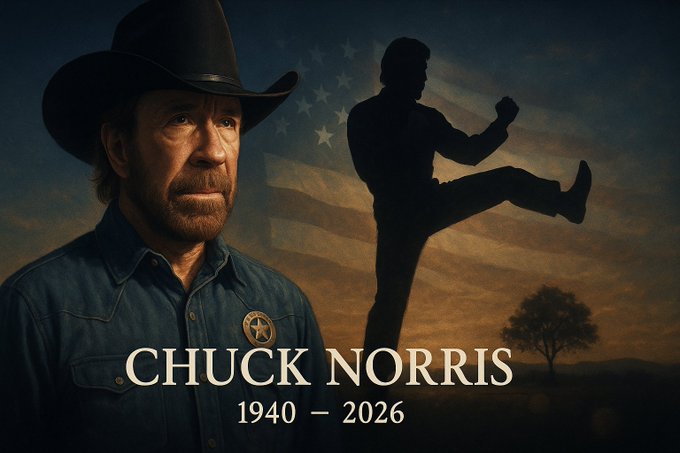
Image / Eulogy Credit: YoloRay “Ax” Chapman
Carlos Ray “Chuck” Norris Jr., born on March 10, 1940, in Ryan, Oklahoma, passed away on March 19, 2026, at the age of 86 on Kauaʻi, Hawaii. Nine days after his birthday. The world loses one of the most defining action stars of the 20th century.
Before Hollywood came calling, Norris was an exceptional athlete. During his service in the U.S. Air Force, he discovered martial arts and became one of their greatest legends. He held black belts in Tang Soo Do, Taekwondo, Judo, and Brazilian Jiu-Jitsu, and eventually founded his own martial art: Chun Kuk Do. From 1968 to 1974, he was the undefeated professional middleweight karate world champion. Six years in a row.
He made his film debut in an uncredited role in the 1969 Matt Helm film The Wrecking Crew, but it was his 1972 role alongside Bruce Lee in Way of the Dragon that first announced him to the world — a performance that generated solid box office returns at the Hong Kong theaters and set the stage for everything that followed.
In the 1980s, he became an icon of action cinema with films like Missing in Action (1984), Invasion U.S.A. (1985), and The Delta Force (1986). Starting in 1993, he played Ranger Cordell Walker for 196 episodes in the CBS series Walker, Texas Ranger across eight seasons, winning millions of fans worldwide.
The passing was sudden. Just nine days before his death — on his 86th birthday — he posted a video of himself training, declaring: “I don’t age… I level up.” His family confirmed he was surrounded by loved ones and at peace. He is survived by his wife Gena O’Kelley, his sons Eric, Mike, and Dakota, his daughters Danilee and Dina, and a number of grandchildren.
Off-screen, he founded the nonprofit organization Kickstart Kids, which promotes martial arts as personal development for youth in middle schools.
The Fighter Who Rewrote the Rules
Norris did not merely practice martial arts — he inhabited them, synthesized them, and ultimately expanded what they could be. His journey began at Osan Air Base in South Korea in the late 1950s, where as a young Air Force serviceman he encountered Tang Soo Do, a Korean striking art emphasizing powerful kicks and linear hand techniques. It was a chance encounter that would redirect the entire course of his life.
Returning to the United States after his 1962 discharge, Norris threw himself into training with a competitive seriousness that set him apart from his contemporaries. He cross-trained extensively at a time when the martial arts world was largely siloed — practitioners of one discipline rarely engaged with another. Norris ignored those boundaries. He pursued Taekwondo for its dynamic kicking range, Judo for its throwing and grappling principles, and later Brazilian Jiu-Jitsu, making him one of the earliest prominent American figures to recognize the ground game as an essential dimension of combat — decades before the UFC would prove that point to the mainstream.
His competitive record was extraordinary. Between 1968 and 1974, he held the Professional Middleweight Karate World Championship without interruption, compiling a career record that cemented his reputation not as a movie tough guy playing at combat, but as a genuine, tested fighter. He trained alongside and against some of the most formidable martial artists of the era, including Joe Lewis and Allen Steen, and earned their respect on the mat before he ever earned the camera’s.
But his most enduring contribution to martial arts was not his trophy record — it was Chun Kuk Do.
Developed over years of training, competition, and philosophical reflection, Chun Kuk Do — meaning “The Universal Way” — was formally codified by Norris in 1990. Rather than champion any single tradition, Chun Kuk Do was built as a deliberate synthesis: a hybrid system drawing from Tang Soo Do as its structural spine, integrated with the long-range kicking vocabulary of Taekwondo, grappling and throwing elements from Judo, and ground fighting principles informed by his later Brazilian Jiu-Jitsu study. It was, in essence, a martial art designed by someone who had stress-tested its components in actual competition rather than theoretical isolation.
What distinguished Chun Kuk Do from other hybrid systems of the era was its explicit philosophical dimension. Norris embedded a code of conduct — thirteen rules governing personal integrity, honor, and responsibility — directly into the art’s curriculum. The system was never intended to produce fighters alone. It was intended to produce people. Students were expected to commit not just to physical development but to a defined ethical framework, making Chun Kuk Do as much a character discipline as a combat system.
The United Fighting Arts Federation, which Norris founded to govern and promote Chun Kuk Do, grew to encompass thousands of practitioners across multiple countries. His celebrity amplified its reach, but the system’s longevity was earned by its substance. Instructors certified under the federation carried the curriculum into schools and communities far beyond the reach of any film or television appearance.
His influence on American martial arts culture more broadly is difficult to overstate. At a time when karate schools were still a novelty in most American cities, Norris operated a chain of studios whose celebrity clientele — Steve McQueen, Bob Barker, Priscilla Presley — brought the discipline into mainstream cultural conversation. His films then did for a mass audience what his studios had done locally: they made martial arts legible, aspirational, and American. The wave of enrollment that followed his 1980s peak sent millions of children and adults through dojo doors for the first time.
He was not Bruce Lee’s philosophical breadth, nor was he trying to be. What Norris represented was something different: the possibility of mastery through discipline, accumulated methodically over decades, without genius as a prerequisite. That was, in its own way, a more democratic and perhaps more durable message.
The Legend Beyond the Screen
Few cultural figures have inspired a genre of humor so distinctly their own. In the mid-2000s, the internet gave birth to what became known as “Chuck Norris Facts” — a sprawling, self-propagating canon of hyperbolic one-liners that spread across forums, chain emails, and early social media with a velocity that predated the word “viral” being applied to content at all.
The format was deceptively simple: state an impossible physical or metaphysical feat and attribute it to Chuck Norris as established fact. Chuck Norris doesn’t do push-ups — he pushes the Earth down. Time waits for no man, but it waits for Chuck Norris. Death once had a near-Chuck-Norris experience. The jokes required no setup, no punchline architecture, and no shared frame of reference beyond a vague cultural familiarity with the man’s stoic, indestructible screen persona. That was precisely the point.
What made the phenomenon remarkable was not the individual quips but their cumulative literary effect. Taken together, the “Chuck Norris Facts” functioned as a kind of distributed folk mythology — the oral tradition of the broadband era. Each entry reinforced a singular archetype: the man who exists outside ordinary physical law, who bends causality by sheer force of will, who is less a person than a cosmological constant. It was absurdist humor with the structural DNA of tall tales, the American frontier legend refracted through a lens of postmodern irony.
The genre also revealed something true about how iconography operates. Norris himself had long since become a sign more than a man — a signifier of a particular strain of unapologetic American toughness that the jokes could simultaneously celebrate and gently lampoon. He was in on it. He appeared in a Pepsi Super Bowl ad riffing on the meme, acknowledged the phenomenon in interviews with good humor, and in doing so became perhaps the only action star to achieve a second, entirely separate cultural life decades after his peak — not through a comeback film or a reboot, but through the collective imagination of the internet.
The “Chuck Norris Facts” endured because they weren’t really about Chuck Norris. They were about the idea of him — immovable, undefeatable, older than time itself. In that sense, the meme may outlast almost everything else. The roundhouse kick echoes forward.
Chuck Norris was more than a myth. He was a soldier, athlete, actor, and philanthropist. A life that could keep up with every one of his roles.